But Won’t Conducting Our Campaign In-House Save Us Money?
The short answer? No. But having been a pastor for 25 years, I get why the question is asked — I’ve asked it myself.
The long answer:
Launching a capital campaign can be daunting for any organization. Conducting the campaign in-house may seem like the least expensive option at first. After all, why hire a consultant when you already have people who care about your organization, mission, and donors?
The reality is that just because something is the least expensive option, that doesn’t mean it will leave your organization with the most net proceeds at the end of the campaign. Nor does it mean your leadership will be healthy and equipped to lead your organization after the campaign.
An internal campaign still incurs expenses. Sometimes those are budgeted line items. Other times not. Internal staff will need to divert time from their regular duties to lead the campaign. Clergy, executive directors, development staff, and volunteers will need to become educated on a complex process while also shouldering the responsibility of leading it. That work typically includes:
— Developing materials and analyzing data
— Coordinating meetings and training volunteers
— Identifying and nurturing prospects
— Asking for major gifts
Every hour spent on campaign work is an hour taken away from something else. If your organization needs to hire additional staff or contract hours to help manage the workload, your “no-cost” campaign just got a lot more expensive.
There is also an unseen human cost.
LEADERSHIP BURNOUT
The Strain Falls on Those Already Stretched Thin
Campaigns often place the most strain on those who have the most on their plates already. Pastors, executive directors, development officers, board chairs, and small teams of highly motivated volunteers often find themselves responsible for every detail of the campaign. They continue to do their day-to-day jobs while managing meetings, communications, strategies for major donors, calendars full of volunteer opportunities, and the emotional labor of asking others to give.
That lifestyle might be possible for a few weeks or months. But campaigns are typically not short. As the months and years wear on, burnout can lead to slow decision-making, inconsistent messaging, missed follow-up, damaged relationships, and diminishing passion. It is not uncommon for leaders to finish a successful campaign only to find they have no energy to celebrate the accomplishment — or lead the organization forward into its next phase of ministry.
Burnout can also lead to real-dollar costs for your organization. When an employee cuts back hours, takes a medical leave, or resigns, your organization could face recruiting fees, transition costs, and training expenses. Those who remain may carry on, but an overtaxed leadership team can lose ground in annual giving, program engagement, volunteer development, or other critical areas. These costs typically don’t show up in your campaign budget. But they are very real costs of conducting the campaign.

OUR APPROACH
Discerning Partners believes in safeguarding your organization from this pattern. Instead of allowing the campaign to become the responsibility of one or two people, we help you build teams to share the work among a group of leaders and volunteers. The campaign becomes part of everyone’s job — not an additional project stacked onto an already-full workload for your busiest staff members.
We also place people into campaign roles that match their interests, gifts, and talents. Someone who loves hosting can help plan events. A natural storyteller can serve on the communications team. A relational person can help engage donors. A detail-oriented person can assist with numbers or campaign administration. When people do work they’re excited about and that matches their strengths, they’re far less likely to burn out.
Developing your campaign leadership team does more than prevent exhaustion. It also builds consensus for the campaign, develops new leaders, strengthens relationships, and increases your organization’s capacity to do ministry well beyond the life of the campaign.
And the biggest cost of an in-house campaign might be what it doesn’t produce.
LESS DONATIONS
What Professional Guidance Is Actually Worth
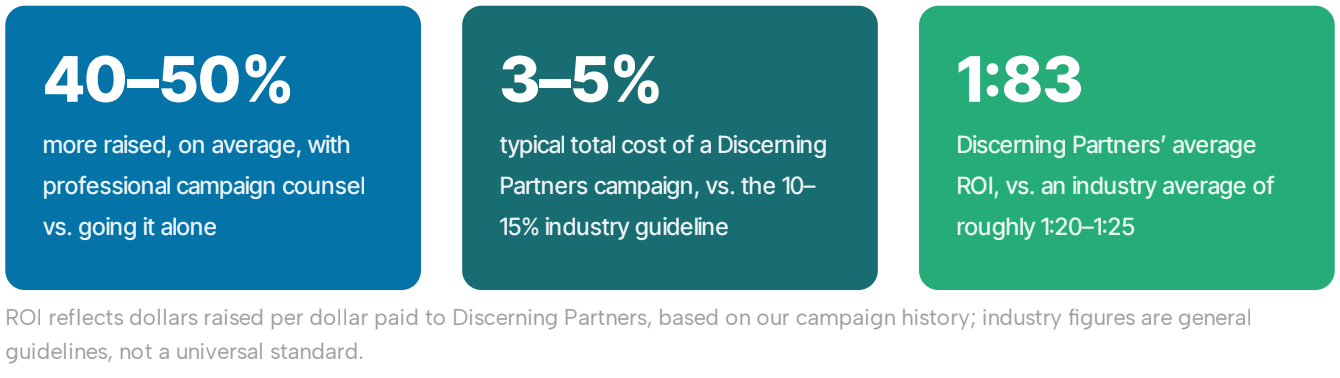
While there is no universally agreed-upon study that tracks every type of campaign across the nonprofit sector, multiple published reports analyzing recent campaign statistics have shown that organizations who used professional campaign counsel raised, on average, 40–50 percent more than organizations who conducted their campaigns without professional guidance. At Discerning Partners, we’ve seen why — we’ve been asked to step into multiple campaigns that started internally and ground to a halt.
Professional guidance helps you identify how much is possible to raise. It helps you understand your donor base, set an appropriate goal, prioritize your donor cultivation, craft strategic request amounts, prepare your leaders for the tough conversations, and maintain momentum. Going it alone may leave you guessing at your potential, starting your public phase too early, relying too heavily on broadcasting to all donors, or simply asking for much less than your donors would have been willing to give.
Capital campaign watchdog groups suggest budgeting around 10–15% of your campaign goal to cover all campaign expenses for campaigns in the $3M–$10M range — consultant fees, staffing, communications, events, travel, and materials. At Discerning Partners, our total campaign expenses usually run 3–5%, largely because we simply charge less to do the same work.

Doing your campaign in-house can save you the cost of a consulting bill. But it doesn’t mean your
campaign won’t cost your organization time, lost opportunities, lower fundraising totals, disruption, or
burned-out leaders.
× THE WRONG QUESTION
“How can we spend the least amount of
money possible to do this campaign?”
✓ THE RIGHT QUESTION
“How can we raise what we need while
keeping our people healthy, growing our
organization, and ensuring everyone
involved is energized and ready to
serve?”
Take that question to your team. Compare it to your in-house plans. Here’s what you’ll likely find.
Discerning Partners exists to help you raise what you need — without burning out the people you need most to lead you there.